The Fourth Way: How Our Students Avoid the Hidden Traps of College Admissions
Long before the start of the COVID-19 pandemic, I had already seen a litany of mental health problems on elite college campuses. At Duke, I was hearing constantly about how students felt like they were never achieving enough. Even as they crushed the academic challenges, many students felt like they couldn’t find their passions and “weren’t good enough,” competing and comparing themselves to each other.
After I graduated and started working in Fortune 500s and VC-backed startups, I saw the same problems. People spent most of their days frustrated, stressed, and disengaged. Organizations and jobs weren’t just soul-crushing, but downright toxic. These were organizations where Stanford, MIT, Vanderbilt, Columbia, and Berkeley graduates worked. They were smart and capable, yet often miserable.
What surprised me most of all was how often this was also happening in college admissions. Working in an elite firm in one of the largest economic centers in America, I saw kids being pushed toward elite institutions and career paths by stressed and anxious families. No one bothered to watch or sense what really helped students come alive and at every turn, people were being forced into a choice between prestige and purpose. The message was clear: to survive, you must be anything but yourself.
Behind the curtain of elite branding and polished essays, I saw students unraveling, families panicking, and consultants giving advice that felt more like minimizing the kid’s real instincts than actual guidance. Then I saw the same problems show up in people’s jobs, professions, and lives decades later. I kept wondering: why are we sending people on false paths when the most distinctive and compelling strategy, both within and beyond admissions, is supposed to be authenticity?
Because our systems are frequently upheld by that very distortion. The low college satisfaction rates, high rates of mental breakdown, sudden dropouts, and years that young professionals were spending in therapy all make sense when you consider this. The “tips and strategies” everyone is given and the absence of authentic alignment work for students leads people down one (or more) of three costly paths:
The Three False Paths: Misery, Mediocrity, and Drift
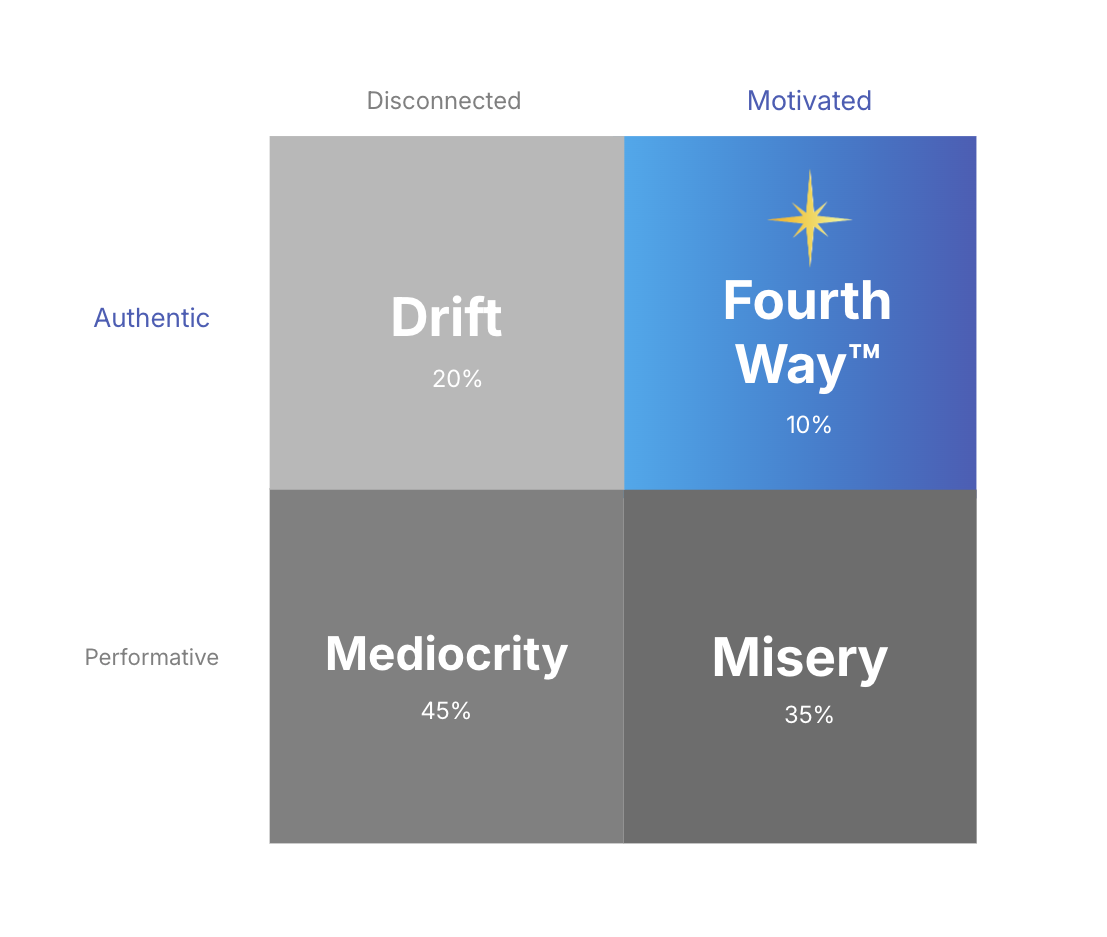
Percentage of students and adults primary in each state, based on more than a decade of observation across workplaces, communities, and admissions advising
1) Successful But Miserable: Achievement Without Alignment
Core Attributes: Performative, Motivated
Students on this path are high-achieving, tightly wound, and quietly burning out. They use material success to make up for deeper levels of unhappiness and regret. The brave ones attempt to seek alignment and congruence within themselves after years of self-abandonment. Smart ones start having this conversation early: what really makes me come alive, and what’s a viable strategy in for the path ahead? How does what makes me come alive create a genuine competitive advantage in the field?
Students and graduates from top universities (Princeton, Penn, Columbia, Cornell, UVA) often come to me in adulthood burned out and misaligned. One can’t leave their prestigious consulting firm job because they feel they’ll never survive without it. Others leave their home countries, fly overseas, climb the corporate ladder, and secure a VP position at investment banks halfway around the world, yet they’re miserable. Other students get into elite universities and drop out because the fit was never correct.
2) Comfortable Mediocrity: Limited Authenticity, Alignment, or Achievement
Core Attributes: Performative, Disconnected
Students on the path of comfortable mediocrity get the acceptance letter, land a job, but often go into an area that barely lets them self-actualize. They play small to stay safe, and their vitality and potential slowly fades into the background. Sometimes they get business or STEM degrees for the security but never branch beyond it, when they were never were meant to do it. They’re in survival and compliance mode most of the time, and instead of improving and growing, their net effect is a slow deterioration and decay. They justify the mediocrity and quietly reminisce about what could have been.
These are self-created limitations more often than externally imposed ones. When families seek this path for their kids, they’re usually doing so with good intentions, hoping to set them up for success and offer them a stable future. But how stable is something that doesn’t work with the kid’s operating system? When families suggest this route, most consultants either push students into one of the other categories (successful but miserable or anti-achievement drift), or they don’t question it, and advise students in a way that reinforces this very mediocrity and malaise.
3) Perpetual Drift: Authenticity Without Achievement
Core Attributes: Authentic, Disconnected
Students on the path of perpetual drift have been so bent out of shape for the sake of fitting in or being worthy that their lives become the expression of a deep and hidden fracture: they have left themselves or gone in search of themselves to the point where the student, well into adulthood, wanders and circles in a way that never resolves.
This path can occur when students experience a deep soul-level fracture or receive a message that wounds their esteem. Unsupported, they drift. They compensate. They create stories rather than get to the root of the problem. The problem is that while exploration can be foundational to later success, extended divergence or subsequent settling rather than focus is almost guaranteed to lead to regret.
When liberal arts programs are not positioned as true learning, for example, but a counselor offers the liberal arts as a path of abandonment and resignation (“yes, you should take the liberal arts! By the way, I have no clear direction for you.”) rather than an intentional, strategic investment paired with a practical and aligned career and life strategy, students can become deeply lost. Pair this with family dissonance, and you get students who are lost for years, sometimes decades, without meaningful wins.
The Fourth Way™: How to Escape the Matrix of Misery
Core Attributes: Motivated, Authentic
What if you could align and eliminate these trade-offs from the beginning? What if you could ensure not just high engagement but also success and distinctiveness without sacrificing your student’s uniqueness? What if you could ensure your student’s growth and uniqueness without sheltering or coddling them from the realities of life?
The Fourth Way™ creates authentic, self-aligned success and identifies the right systems and strategies to support student emergence rather than conform to systems that dim their capacity and brilliance. It’s premised upon one radical idea: simply being yourself—and finding who that is—will change everything for your strategy. Prestige isn’t the point. Discover alignment, and prestige becomes irrelevant.
Our students and families consistently report feeling seen—truly seen, for the first time, and directed on paths that actually feel like them. They have fully escaped competition because they have discovered what authenticity really means and gained a level of insight and self-understanding that no one can take away. Here’s what one parent said after their high-performing student struggled for months to write the personal essay:
“We’ve been around the block and struggled for months. Rayner, this essay is beyond gorgeous. I can't thank you enough for knowing what to pull out of her.”
Another student specifically emphasized how authenticity became their guide as they navigated the path ahead:
“Rayner helped me to bring out my true self in my writing. I recommend Rayner to anyone looking for a reliable and understanding counselor who seeks to help you express your story.”
Virtually everyone has the ability to be successful—but do you know how to be successful on your terms? If you're wondering which path your student is on and whether The Fourth Way™ might be the missing piece, I’ve created The Fourth Passage, an experience that walks you through the entire college admissions journey as a multi-generational developmental rite of passage. In The Fourth Passage, we:
Deeply explore the three false paths, the true costs of each, and the signs you’re stuck in one or all of them;
Examine why traditional college admissions consulting often fails and what its real costs are long-term;
Uncover how alignment-first strategy actually works and its multiple forms of ROI.
It’s surprisingly simple but completely elusive to most admissions consultants. The key to a lifetime of sustainable success starts with asking and answering the question: who are you really, and what kind of “idea” are you? Discover which path your student is on, what it’s costing you, and how to shift while there’s still time.
Galaxy Mind builds rite of passage infrastructure for families navigating the college transition. We don't optimize for prestige. We align students with their authentic calling and help parents transform their expectations—creating outcomes that matter beyond acceptance letters. The Fourth Passage is our flagship program launching March 2026.
